
If you’ve just launched a business, you’ve probably heard two pieces of conflicting advice from two different people: “invest in SEO” and “just run some ads.” Both are right — and both are incomplete. The real answer to SEO vs PPC for a new business depends on your budget, your timeline, and how quickly you actually need customers.
This guide breaks down what each option actually does, where each one wins, and how to decide which one your business should start with in 2026.
Table of Contents
What SEO Actually Does
SEO (Search Engine Optimization) is the process of improving your website so it ranks organically in search results — without paying for each click. It covers things like keyword-targeted content, page structure, site speed, and building credible links back to your site.
The upside is that once a page ranks well, it can keep bringing in visitors for months or years without ongoing ad spend. The catch is that it rarely happens fast. Google itself notes that meaningful SEO results typically take several months to show up, especially for a brand-new domain with no existing authority.
What PPC Actually Does
PPC (Pay-Per-Click) advertising — most commonly through Google Ads — puts your business at the top of search results immediately, but you pay for every click. Turn the campaign off, and the traffic stops the same day.
PPC is fast and highly controllable. You can target a specific city, a specific search phrase, even a specific time of day, and see results within hours of launching. That precision comes at a cost per click that can add up quickly in competitive industries.
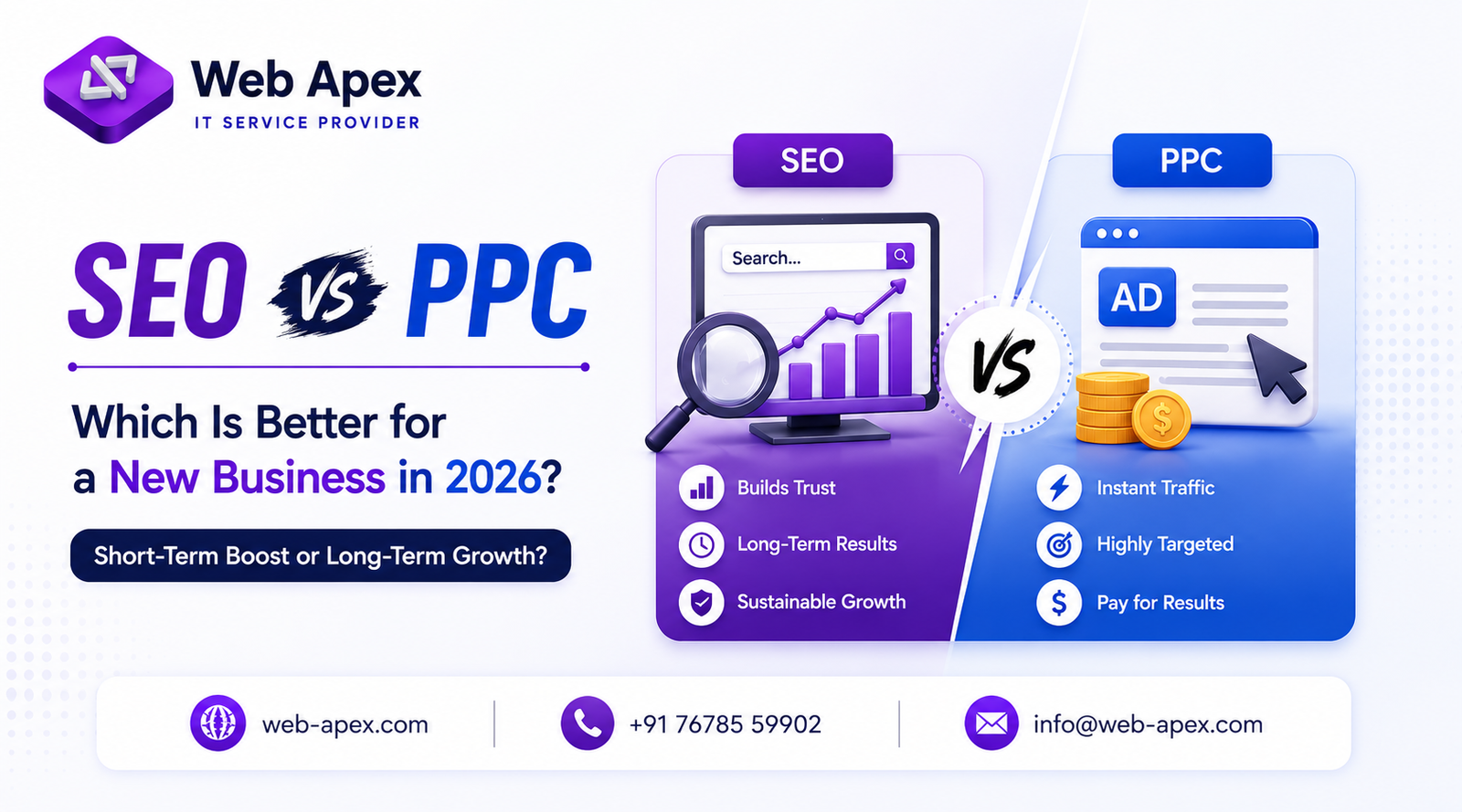
SEO vs PPC: The Core Differences
| Factor | SEO | PPC |
|---|---|---|
| Time to results | 3–6+ months | Same day |
| Cost structure | Time + content investment | Pay per click |
| Traffic after you stop | Continues (slowly declines) | Stops immediately |
| Best for | Long-term brand visibility | Immediate leads/sales |
| Trust factor | Often seen as more credible | Clearly marked as an ad |
| Budget control | Harder to predict | Fully controllable, capped daily |
SEO vs PPC for New Business Owners: The India Context
For a new business in India, the numbers on each side look quite different. A basic SEO effort — targeting a handful of low-competition, city-specific keywords — can realistically start showing early movement in 3 to 5 months, and typically costs far less per month than an equivalent PPC budget once you factor in the long-term traffic it keeps generating for free.
PPC through Google Ads, on the other hand, usually costs anywhere from ₹10 to ₹80+ per click in India depending on the industry — service businesses like clinics, lawyers, or B2B software tend to sit at the higher end, while local retail and simpler services are often cheaper. That means a modest ₹15,000–₹25,000/month PPC budget might only buy a few hundred clicks in a competitive category, which is worth knowing before committing a large share of a limited launch budget to ads alone.
When SEO Makes More Sense for a New Business
SEO tends to be the stronger long-term play if:
- You’re building a business you plan to run for years, not months
- Your industry isn’t hyper-competitive on paid search
- You have the patience (and content) to invest before seeing returns
- You want to reduce dependence on ad spend over time
A new business with a well-built website and a consistent content plan can start showing up organically for long-tail, lower-competition searches within a few months — well before it ever competes for the expensive, high-volume keywords.
When PPC Makes More Sense for a New Business
PPC is usually the better starting point if:
- You need customers now, not in six months
- You’re testing which offers, keywords, or messaging actually convert
- Your business is seasonal or tied to a specific launch window
- You have a clear enough margin to know what a customer is worth to you
Because PPC gives you data almost immediately — impressions, clicks, conversions — it also doubles as market research. You can use Google Ads Keyword Planner to see real search demand before you’ve written a single blog post, which is often the fastest way to validate whether people are even searching for what you offer.
Do You Have to Choose Just One?
Not really. Most new businesses that grow steadily end up running both, just not necessarily at the same intensity from day one.
A common approach: lean on PPC in the first few months to generate leads while the website is new and has no organic visibility, while simultaneously investing in SEO content in the background. As rankings start to build, PPC spend can be scaled back on the keywords SEO now covers, and redirected toward new campaigns or offers. Think with Google has published research showing that businesses appearing in both organic and paid results for the same search often earn more trust than those relying on just one.
This is typically how a digital marketing strategy is built for a new business — not SEO or PPC in isolation, but a sequence that matches where the business actually is.
A Simple Way to Decide
Ask yourself these questions:
- Do I need revenue this month, or can I invest before seeing returns? → Immediate need leans PPC; patience leans SEO.
- Is my industry expensive to advertise in? → High cost-per-click industries often benefit more from SEO long-term.
- Do I have content or a team to build it? → SEO needs consistent content; PPC needs budget and campaign management.
- How long do I plan to run this business? → Short-term push favors PPC; long-term brand-building favors SEO.
Final Thoughts
There’s no universal winner in the SEO vs PPC debate — the right choice depends entirely on what stage your business is at. PPC gets you visible today. SEO builds visibility that lasts. Most new businesses in 2026 end up needing a bit of both, just in a sequence that fits their budget and timeline.
If you’re not sure where to start, get in touch with Web Apex for a quick look at your industry, budget, and goals — it’s usually enough to point you toward the right starting mix.
Read more: How Much Does Digital Marketing Cost Per Month in India?